
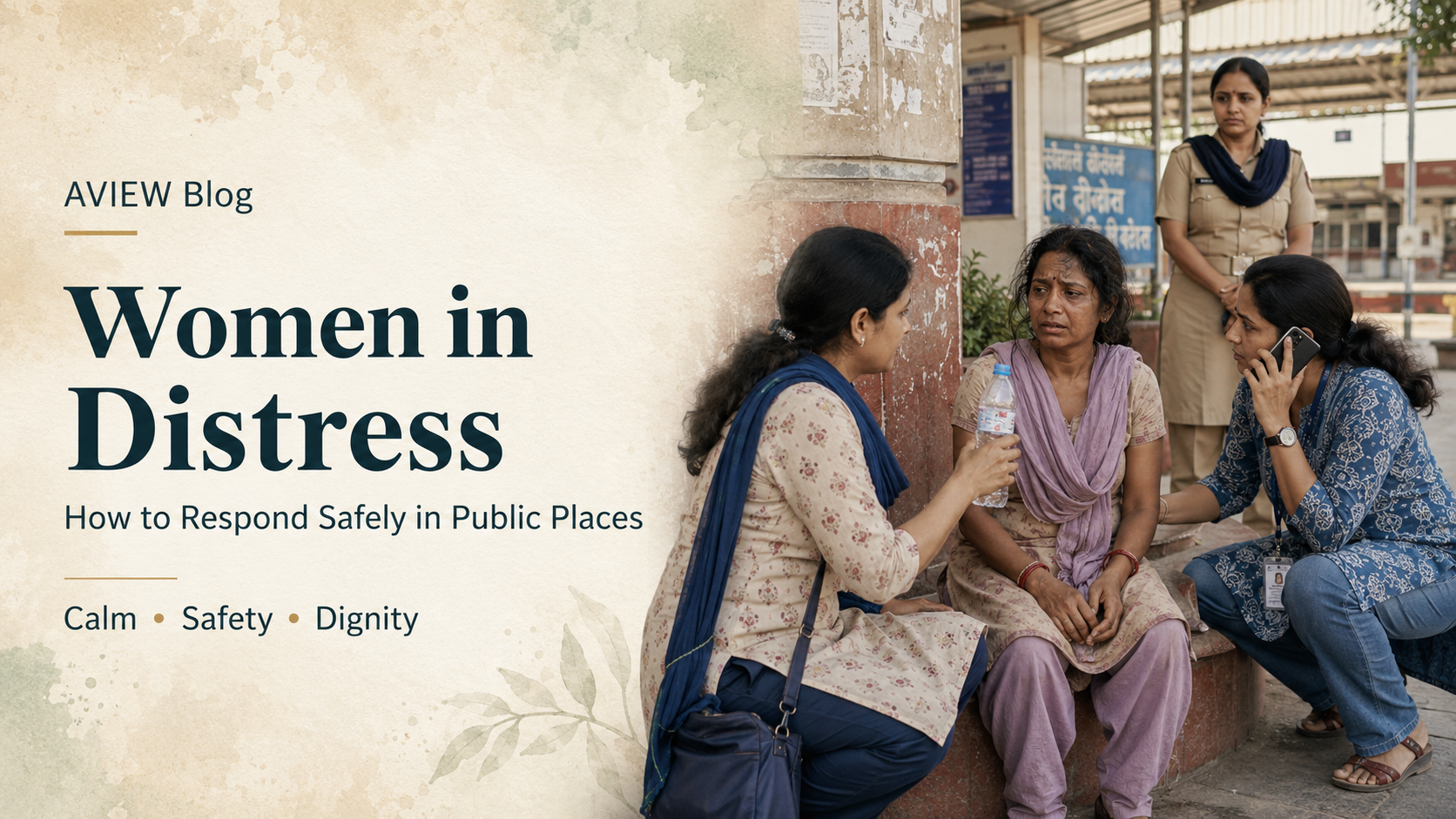
What Should You Do When You See a Psychologically Distressed Woman in Public? A Guide to Helping Women in Distress Safely
When we encounter women in distress in public spaces, our response should be guided by calm, safety, dignity, and care. At AVIEW, A Village for Independent and Enterprising Women, this question is closely connected to our work with destitute, abandoned, and psychologically distressed women with mild to moderate mental illness.
A woman may appear frightened at a railway station. Another may seem confused about where she is. Someone may be crying, speaking anxiously, wandering without direction, or struggling to communicate clearly.
What should you do?
Many women who later require structured support are first noticed in public places by commuters, shopkeepers, railway staff, police personnel, or concerned citizens. However, helping them requires more than good intentions. A rushed, forceful, or highly public intervention can increase fear.
The first task is not to diagnose her. It is to protect her safety, preserve her dignity, and connect her with appropriate support.
First, Do Not Assume You Know What Is Happening
Unusual behavior does not automatically confirm mental illness.
A woman may be experiencing psychological distress, trauma, disorientation, physical illness, neurological difficulty, exhaustion, violence, intoxication, medication-related problems or an unfamiliar environment. She may also be lost, unable to communicate in the local language or frightened by the people around her.
Only qualified professionals can assess her condition properly.
Instead of labelling her, focus on what you can observe:
- Is she physically injured?
- Is she conscious and responsive?
- Is she standing near traffic, railway tracks, water or another hazard?
- Is anyone threatening or harassing her?
- Does she appear frightened by the crowd?
- Can she answer simple questions?
- Is there an immediate risk to her or another person?
This prevents a concerned response from becoming an amateur diagnosis.
Approach Calmly and Ask Permission
If there is no immediate physical danger, one calm person should approach rather than an entire group.
Stand where she can see you. Maintain a respectful distance and leave her a clear way to move away. Avoid blocking her path, surrounding her or standing over her.
Introduce yourself simply:
“Hello, my name is ____. I noticed that you may need some help.”
Then ask:
“Would you like me to stay here with you?”
“Is there someone you trust whom I can call?”
“Do you know where you are?”
“Would you like some water?”
Use short sentences and one question at a time. Speak slowly without sounding patronising. If she does not understand your language, try to find a trusted woman nearby who speaks hers.
The World Health Organization describes psychological first aid as humane, supportive and practical assistance offered in ways that respect a distressed person’s dignity, culture and abilities. Its broad principles can be understood as: look at the situation carefully, listen without pressure and link the person with practical support.
You are not expected to provide therapy. Your role is to make the immediate situation safer and help her reach appropriate care.
Listen Without Interrogating Her
A psychologically distressed woman may tell you something that sounds confused, incomplete or difficult to understand. She may repeat herself, appear suspicious or refuse to answer.
Do not argue with her version of events. At the same time, do not confirm something you cannot verify.
Instead of saying, “That is not true,” try:
“That sounds frightening.”
“I can see that you are worried.”
“Let us first move somewhere quieter and safer, if you are comfortable.”
“You do not have to explain everything right now.”
Do not demand her full history, diagnosis, family details or proof of identity. Ask only what is necessary for immediate safety and referral.
Useful information may include her name, a trusted contact, her home area, whether she is injured, whether she has prescribed medicine with her and whether she feels safe speaking to you.
When Should You Call Emergency Services?
Call India’s Emergency Response Support System at 112 when there is an immediate threat to life or safety.
This may include situations where the woman:
- Is injured, unconscious or medically unwell
- Is in moving traffic or close to railway tracks
- Is near a dangerous height, fire or water body
- Is being attacked, threatened or forcibly taken away
- Has a weapon or access to an obvious means of serious harm
- Is threatening immediate harm to herself or another person
- Cannot be moved away from an immediate physical hazard safely
Do not place yourself in danger. Do not step into traffic, enter railway tracks or physically confront an armed or violent person. Give the emergency operator the exact location, visible risks, nearby landmarks and a clear description of the situation.
If possible, remain nearby at a safe distance until trained help arrives.
What You Should Never Do
Do not film or photograph her
A distressed woman is not public content. Recording her face, behaviour or personal details and uploading them to social media can expose her to ridicule, identification, exploitation and lasting loss of privacy.
Even when the intention is to “find her family,” public circulation should not be the first step. Share necessary information privately with police, emergency services or a recognised organisation.
Do not crowd her
A crowd can feel threatening and may increase fear or confusion. Ask bystanders to step back. One or two calm people are usually more helpful than ten people speaking at once.
Do not touch or restrain her unnecessarily
Do not grab her arms, pull her belongings, push her into a vehicle or hold her down. Physical intervention should be left to trained emergency or medical personnel except when an immediate action is necessary to prevent clear and imminent physical harm.
Do not offer unknown medication
Never give sleeping tablets, psychiatric medicines, sedatives or someone else’s prescription. Medication should be assessed and prescribed by qualified medical professionals.
Do not force food, water or conversation
You may offer water or simple food, but allow her to decide. Do not force her to eat, speak, reveal information or accompany you.
Do not hand her over to an unknown person
Someone claiming to be a relative may not necessarily be safe or truthful. When identity or safety is uncertain, involve police, women’s support services or trained organisations before allowing anyone to take her away.
Protect Her Privacy and Personal Belongings
Dignity in mental health care begins before a woman ever reaches a hospital, shelter or rehabilitation setting.
Do not search her bag, phone or clothing unless an immediate safety situation requires trained personnel to do so. If she gives you a phone number, address or identification document, share it only with relevant authorities or organisations.
Try to preserve her belongings. A bag, photograph, identity card, prescription or piece of paper may later help establish her identity or contact her family.
If she needs to wait for help, choose a visible but relatively quiet space. Where possible, ensure that another trusted woman remains nearby.
Which Support Service Should You Contact?
Different situations require different kinds of help.
Immediate danger or medical emergency: Call 112
The pan-India Emergency Response Support System connects citizens with police, fire and rescue, health and other emergency assistance.
Mental-health guidance: Contact Tele-MANAS
For non-immediate mental-health guidance, India’s Tele-MANAS service can be reached at 14416 or 1800-89-14416. The programme provides round-the-clock tele-mental health support and linkages to further services.
Tele-MANAS is not a substitute for emergency response when someone is in immediate physical danger. Call 112 first in such cases.
Violence or a women’s safety concern: Contact the NCW Women Helpline
The National Commission for Women’s helpline at 14490 supports adult women in distress, particularly women affected by violence. It can facilitate counselling and referrals to authorities such as police, hospitals, legal services, protection officers and One Stop Centres.
Local police, hospital or district services
Police stations, government hospitals, psychiatric departments and district mental-health services may also be necessary depending on the situation.
When calling, provide clear facts rather than conclusions. Say what you can see, where the woman is, whether she is injured and what immediate risks are present. Avoid simply saying, “There is a mentally ill woman here.”
When Should You Contact an NGO?
An NGO for women with mental illness in India can become relevant after immediate safety has been addressed and a responsible referral pathway has begun.
The need for such support is consistent with the wider movement towards community-based mental health care, including psychosocial rehabilitation, supported living and social participation.
A specialised NGO may help with:
- Safe residential care
- Mental-health assessment and treatment support
- Assistance with prescribed medication
- Daily living routines
- Emotional and psychosocial support
- Family tracing and verification
- Rehabilitation for women with mental illness
- Vocational and livelihood skills
- Social reintegration for women
- Longer-term supported living
However, an NGO is not automatically an emergency ambulance, police service or walk-in admission facility. Each organisation may have specific eligibility criteria, legal procedures, staffing limits and available capacity.
Do not force a woman into your vehicle and drive her to a facility without prior coordination. Contact the organisation first, explain the situation accurately and follow its referral guidance.
For an AVIEW-related referral, contact AVIEW before bringing a woman to the facility so that the team can explain its criteria, process and current capacity.
People searching for a women mental health NGO Kolkata or a women rehabilitation NGO West Bengal should verify whether the organisation has trained staff, residential capacity, psychiatric support and a defined process for referrals.
Similarly, an online search such as “rehabilitation centre for women India” should be followed by careful verification. A website alone does not establish the quality, safety or suitability of a care facility.
How AVIEW Supports Destitute Women with Mental Illness
AVIEW is an unlocked residential rehabilitation model for destitute women with mild to moderate psychiatric illness.
Through the AVIEW pathway, eligible women may be identified through psychiatric wards, halfway houses, police stations and public locations, including railway platforms. Trained social workers help coordinate identification and interaction.
Once admitted through the proper process, residents receive a safe living environment, medical care, food, clothing, assistance with prescribed medication and support with activities of daily living.
Care also includes practical and marketable skills such as cooking, cleaning, gardening, sewing, quilting, jewellery-making, animal care and farming-related activities. These are not presented as cures. They are parts of a wider environment of routine, participation, confidence and dignity.
As an NGO supporting destitute women in India, AVIEW’s work continues beyond immediate safety. Its approach considers rehabilitation, independence, livelihood, family reconnection where appropriate and community acceptance.
AVIEW’s stories of recovery and reconnection show how this patient process can unfold differently for every woman.
This is why responsible public referral matters. The way a woman is treated during the first encounter can affect whether she reaches care feeling protected or further frightened.
Helping Does Not Mean Taking Control
A woman experiencing distress still has a voice.
Where there is no immediate danger, tell her what you are doing before making a call. Ask whether she is comfortable speaking with a female responder. Explain who is coming and why.
If she declines help and there is no immediate risk, avoid forcing her. You may remain at a respectful distance, offer information or consult a mental-health service for guidance.
If there is imminent danger, severe injury or an inability to remain physically safe, contact emergency professionals and follow their instructions.
The goal is not to control her. It is to reduce immediate risk while preserving as much choice, privacy and dignity as possible.
A Better Public Response to Women in Distress
The public often becomes the first point of contact for destitute women with mental illness. That gives ordinary citizens an important responsibility.
A responsible response is not dramatic. It may simply mean asking a crowd to step back, offering water, speaking gently, calling 112, contacting Tele-MANAS, protecting her identity or waiting until trained support arrives.
Women in distress do not need to be turned into spectacles. They do not need interrogation, mockery or force disguised as concern.
They need a response that recognises their humanity first.
As an NGO for women with mental illness in India, AVIEW believes that dignity, care and belonging must remain central to every stage of support. That principle begins not only inside a rehabilitation home, but in the railway station, marketplace, pavement or neighbourhood where someone first decides not to look away.
Readers who believe in long-term, dignity-first care can also support AVIEW’s work with destitute women.
Frequently Asked Questions
1. Should I call the police when I see a psychologically distressed woman?
Call 112 when there is immediate danger, violence, serious injury, a medical emergency or a threat to safety. For a non-immediate situation, you may also contact Tele-MANAS, women’s support services or a recognised mental-health organisation for guidance.
2. Can I take her directly to a shelter or NGO?
Do not transport her without consent and prior coordination unless trained emergency professionals instruct you to do so. Contact the organisation first. Admission may require assessment, documentation, legal coordination and available capacity.
3. What should I say to a woman who appears confused or frightened?
Introduce yourself, speak calmly and ask simple questions. You can say, “You seem worried. Would you like help?” Avoid demanding explanations, arguing, making promises or asking several questions at once.
4. What if she refuses help?
If there is no immediate threat, respect her space and seek professional guidance. If she is at imminent risk of serious harm, call 112 and explain the situation clearly.
5. How can an NGO for women with mental illness in India help after the immediate crisis?
A specialised NGO may support safe accommodation, treatment coordination, daily routine, rehabilitation, family tracing, vocational training for women and gradual social reintegration. Services depend on the organisation’s criteria, capacity and referral process.