
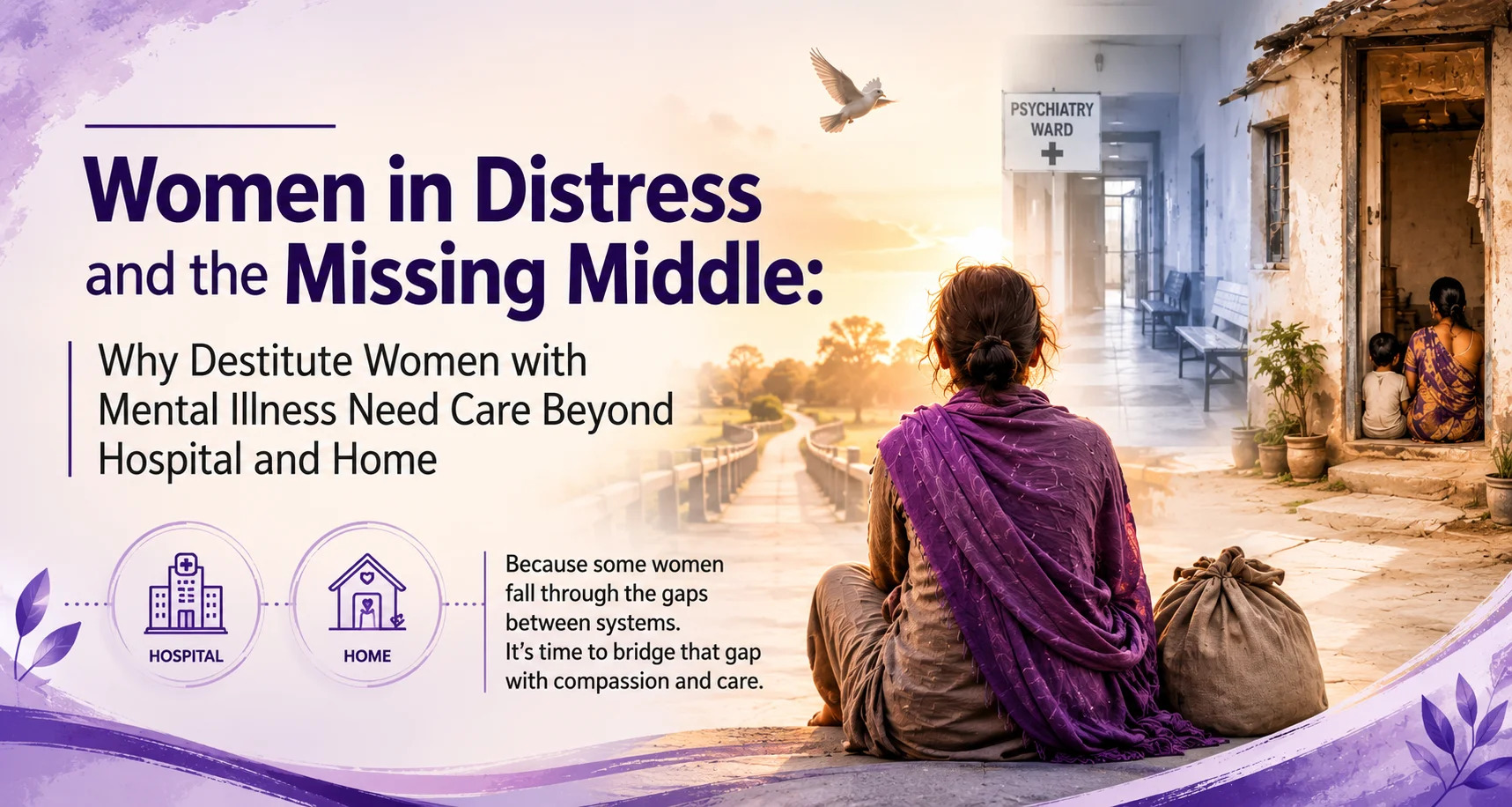
Women in Distress and the Missing Middle: Why Destitute Women with Mental Illness Need Care Beyond Hospital and Home
Care for women in distress cannot stop at the moment of rescue.
For AVIEW, A Village for Independent and Enterprising Women, this belief sits at the heart of its work with destitute, abandoned, and psychologically distressed women with mild to moderate mental illness. Many women may receive emergency rescue or hospital-based treatment, but the deeper question often begins after the immediate crisis has passed: where does she go next if home is absent, unsafe, unwilling, or unable to support her?
A hospital may help during an acute phase. A family may not always be present, prepared, safe, or willing to provide long-term support. A temporary shelter may offer protection for a short while, but may not have the structure needed for psychiatric rehabilitation.
This is the missing middle.
It is the space between hospital and home. Between rescue and restoration. Between survival and a life rebuilt with dignity.
For destitute women with mental illness, this space matters deeply. They need more than a roof. They need safety, treatment support, daily rhythm, emotional care, vocational skills, community acceptance, and the patient possibility of beginning again.
Who Are Women in Distress?
Women in distress are not defined by one circumstance.
Some may be living with mental illness. Some may have been abandoned by their families. Some may be facing homelessness, poverty, violence, neglect, or social rejection. Others may have no safe home to return to, no caregiver who can support them, or no access to consistent mental health care.
Through AVIEW’s lens, women in distress include destitute women with mental illness who need structured care, not pity. According to WHO, mental health is shaped by social, economic, and environmental conditions. Their distress may be visible in the form of homelessness or abandonment, but the need beneath it is often more layered.
They may need medical support. They may need emotional stability. They may need help rebuilding trust. They may need daily routines that make life feel safe again. They may need time before they can speak, work, reconnect, or participate in community life.
Most importantly, they need to be seen as women with dignity, not as cases to be managed or problems to be moved elsewhere.
The Missing Middle Between Hospital and Home
In mental health care, crisis response is essential. Hospital-based treatment can support women during severe distress, relapse, or urgent psychiatric need. But many women also need care after the crisis has settled.
This is where the gap appears.
WHO stresses the value of community-based mental health care, including psychosocial rehabilitation, supported living, and support in non-health settings. For women who cannot safely return home, this makes the space between hospital and home a critical part of recovery.
A woman may be medically stable enough to leave a hospital, but not ready to live independently. Her family may be difficult to trace. In some cases, the home environment may not be safe or supportive. In others, relatives may not understand mental illness or may feel unable to provide continued care.
Generic shelters can offer temporary protection, but destitute women with mental illness often require a deeper form of support. They may need assistance with medication, hygiene, nutrition, emotional regulation, counselling, daily living skills, and social confidence.
The missing middle is not a luxury. It is a necessary bridge.
Without it, many women risk returning to unsafe conditions, repeated distress, or social isolation. With it, they can slowly move from instability towards trust, routine, and belonging.
Why Destitute Women with Mental Illness Need More Than Temporary Shelter
A safe shelter for women in distress is an important first step. But shelter alone is not rehabilitation.
Temporary shelter may protect a woman from immediate danger, but rehabilitation asks a more patient question: what does she need to live with dignity again?
For destitute women with mental illness, the answer often includes:
- Safe accommodation and daily care
- Psychiatric support and medication assistance where prescribed
- Nutritious food, hygiene, and rest
- Emotional support and counselling
- Routine and meaningful daily activity
- Life skills and vocational training
- Community living and gradual trust-building
- Long-term planning for reintegration, where possible
This is why rehabilitation for women with mental illness must be structured, gentle, and consistent. Recovery is not only about symptoms. It is also about the environment around a person.
A woman who has spent months or years in distress may not immediately feel safe in a new space. She may need time to understand that food will come, that care will continue, that people will speak to her with respect, and that her life still has value.
That kind of care cannot be rushed.
The Role of an NGO for Women with Mental Illness in India
An NGO for women with mental illness in India can play a vital role in this missing middle, especially when women are destitute, abandoned, or without family support.
A specialised organisation can offer what many systems struggle to provide together: safe shelter, psychiatric care coordination, emotional support, routine, community living, vocational training, and a pathway towards social reintegration.
This is different from a generic charity model. It is not only about giving food, clothing, or shelter. It is about creating a care environment where a woman can gradually rebuild her inner and outer life.
For an NGO supporting destitute women in India, the responsibility is not simply to rescue. It is to stay with the woman through the slower work of rehabilitation.
That may mean helping her relearn daily activities. It may mean supporting her with treatment adherence. It may mean helping her discover skills she can use. It may mean finding family, rebuilding social connections, or creating semi-independent living pathways when possible.
Why a Rehabilitation Centre for Women in India Must Be Dignity-First
People searching for a rehabilitation centre for women in India are often looking for safety, stability, and long-term support. But the quality of that care matters.
A dignity-first rehabilitation environment does not treat women as passive recipients of charity. It recognises that every woman has a history, a personality, a rhythm, and the right to be treated with respect.
Dignity in mental health care means using language that does not stigmatise. It means offering privacy, patience, and choice wherever possible. It means understanding that progress may be uneven. Some days may be quiet. Some steps may be small. That does not make them less meaningful.
A rehabilitation centre for women in India must also understand that mental health recovery is connected to everyday life. Meals, bathing, sleep, medicine, work, conversation, movement, and companionship all become part of care.
A woman does not rebuild confidence only in a counselling room. She may rebuild it while watering plants, folding clothes, preparing a meal, stitching fabric, feeding animals, or sitting with others in silence.
Ordinary routines can become quiet acts of restoration.
AVIEW’s Approach: Rescue, Rehabilitate, Restore
AVIEW, A Village for Independent and Enterprising Women, works with destitute, abandoned, and psychologically distressed women with mild to moderate mental illness.
Its approach is rooted in three connected stages: Rescue, Rehabilitate, and Restore.
Rescue means bringing a woman into safety. This may involve identifying women who are destitute, abandoned, or in unsafe conditions, and helping them enter a protected care environment.
Rehabilitate means supporting her with treatment, food, housing, clothing, emotional care, hygiene, routine, life skills, and vocational training. It is the stage where safety begins to become stability.
Restore means helping her move towards independence, livelihood, family or community connection where possible, and a more dignified way of living.
This is why AVIEW’s work is best understood not only as shelter, but as a long-term recovery pathway. As an NGO for women with mental illness in India, AVIEW focuses on the full journey from distress to dignity.
Safety Before Recovery
A woman must feel safe before deeper healing can begin.
For destitute women with mental illness, safety is not only physical. It is also emotional. It is knowing that she will not be shouted at, shamed, ignored, or pushed before she is ready.
Safety allows the nervous system to rest. It allows trust to return slowly. It gives care a foundation.
In a dignity-first environment, safety is created through consistent routines, respectful communication, trained support, and a sense of belonging.
Routine as Care
Routine can be deeply therapeutic when it is offered with patience.
Regular meals, rest, hygiene, medication support, shared activities, and predictable daily rhythms can help women regain a sense of stability. When life has been uncertain for a long time, even small routines can feel grounding.
This is why psychiatric rehabilitation for women must include the everyday. A clean room, a warm meal, a familiar face, a garden task, or a quiet evening rhythm can become part of recovery.
Routine does not erase distress. But it can make life feel less frightening.
Skills That Help Women Begin Again
Vocational training for women is not only about income. It is also about confidence, identity, and participation.
When women learn or return to skills such as gardening, stitching, animal care, cooking, organic farming, craftwork, or other livelihood activities, they begin to experience themselves differently. They are not only receiving care. They are contributing, learning, and creating.
For destitute women with mental illness, meaningful work can support self-worth. It can also prepare women for semi-independent living, community reintegration, or livelihood-linked opportunities where appropriate.
Skills help women move from being seen only through their illness to being recognised for their abilities.
How Society Can Support Women in Distress Better
Supporting women in distress is not only the work of institutions. Society also has a role to play.
We can begin by changing the way we speak about mental illness. Words can either deepen stigma or create space for dignity. A woman living with mental illness should never be reduced to a label.
We can also support credible NGOs that work with trained systems, responsible referrals, and long-term rehabilitation models.
Ways to help include:
- Speaking about mental illness with dignity
- Avoiding harmful labels and casual stigma
- Donating responsibly to organisations doing verified work
- Volunteering time, skills, or professional support
- Referring women in distress through proper channels
- Supporting livelihood products made by women in care
- Sharing verified mental health information
- Encouraging families and communities to accept reintegration where safe and possible
Care becomes stronger when the wider community participates.
If someone is in immediate danger or facing urgent risk, contact local emergency services or relevant helplines.
For mental health support, Tele-MANAS is India’s national tele-mental health service and can be reached at 14416 or 1-800-891-4416. For women facing violence or urgent safety concerns, the National Commission for Women’s 24×7 helpline at 14490 is another official support channel for women in distress.
Conclusion: From Abandonment to Belonging
Women in distress need more than rescue. They need the chance to feel safe, to be cared for consistently, and to rebuild life at a pace that respects their dignity.
For destitute women with mental illness, the journey often cannot move directly from hospital to home. Many need the missing middle: a place where treatment support, routine, emotional care, vocational skills, and belonging come together.
AVIEW stands in this space as an NGO for women with mental illness in India, working with women who may have been abandoned, forgotten, or left without a safe support system.
A woman is never only her illness. She is not only her past. With care, time, and community, she can recover parts of herself that distress may have hidden.
That is the deeper promise of rehabilitation: not just shelter, but dignity. Not just survival, but belonging. Not just rescue, but the possibility of beginning again.
FAQs
What does “women in distress” mean?
Women in distress may include women facing abandonment, homelessness, violence, poverty, mental illness, neglect, unsafe living conditions, or lack of family support. In AVIEW’s context, the term especially includes destitute women with mental illness who need safe, structured, long-term care.
Why do destitute women with mental illness need rehabilitation?
Destitute women with mental illness may need more than temporary shelter or short-term treatment. Rehabilitation supports them with safety, psychiatric care coordination, medication assistance where prescribed, daily routine, hygiene, nutrition, emotional support, skills, and social reintegration.
What does an NGO for women with mental illness in India do?
An NGO for women with mental illness in India may provide safe shelter, mental health support, rehabilitation, daily care, vocational training, livelihood opportunities, and reintegration support. The goal is to help women rebuild dignity and stability over time.
How does AVIEW support destitute women with mental illness?
AVIEW supports destitute and abandoned women with mild to moderate mental illness through its Rescue, Rehabilitate, Restore approach. It offers safe shelter, care, treatment support, routine, vocational skills, livelihood-linked activities, and pathways towards dignity and social reintegration.
How can I support women in distress safely and responsibly?
You can support women in distress by speaking about mental illness respectfully, avoiding stigma, donating to credible organisations, volunteering your skills, referring cases through proper channels, supporting livelihood products, and sharing verified mental health resources.