
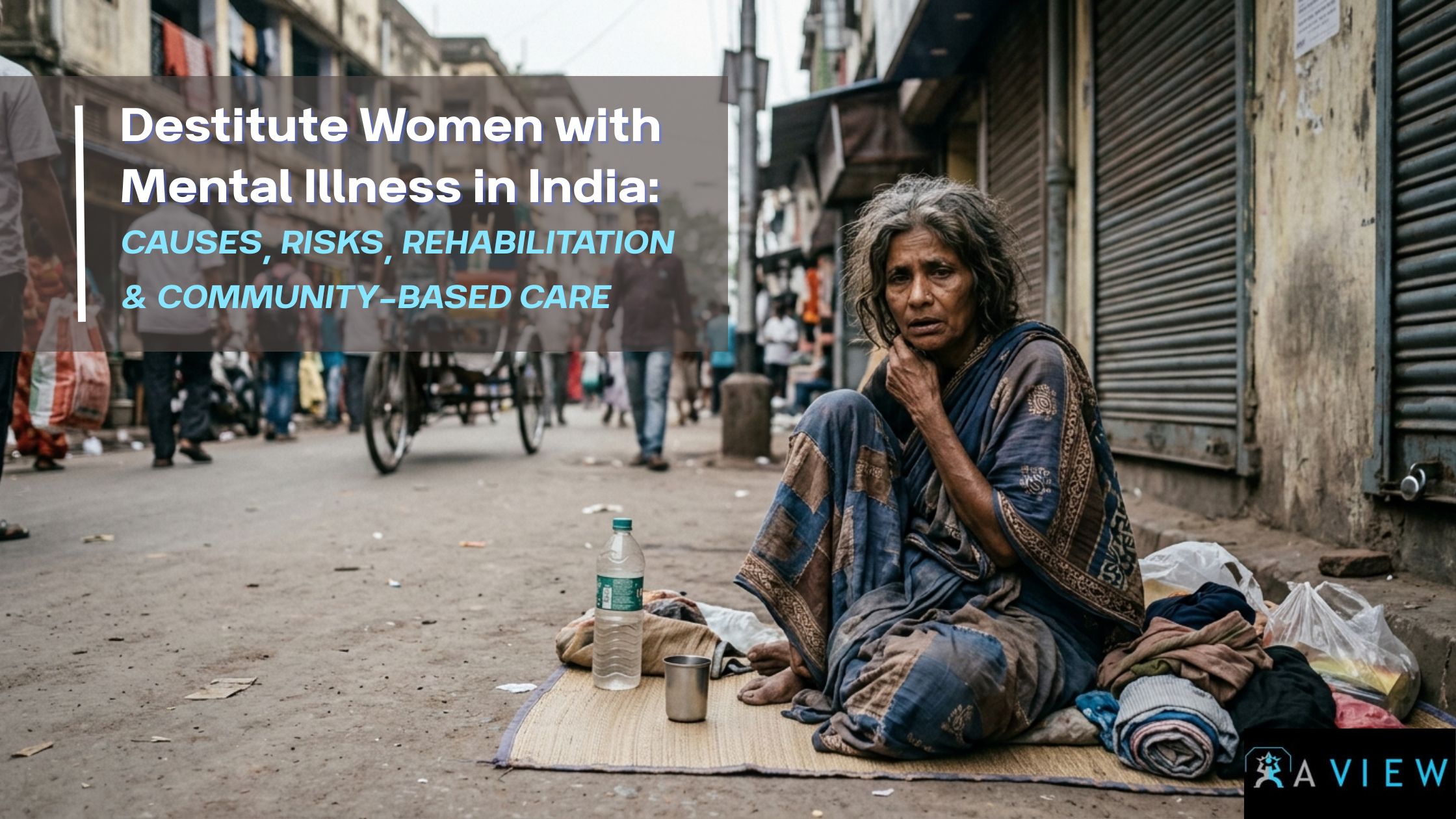
Destitute Women with Mental Illness in India: Causes, Risks, Rehabilitation & Community-Based Care
At A VIEW, the focus is not simply on rescue. It is on what happens after. The organisation works within a reality where many destitute women with mental illness in India have already slipped through multiple systems long before anyone notices them on the street, including family support, healthcare access, social protection, and public empathy.
The street is rarely the beginning. For many destitute women with mental illness in India, it is the endpoint of a long collapse: stigma, untreated distress, family exhaustion, poverty, violence, and the absence of dependable support. By the time a woman is sleeping near a railway platform, under a flyover, or beside shuttered shops where nobody asks questions after midnight, the breakdown has usually happened many times already.
Why Destituteness Is More Than Lack of Shelter for Women With Mental Illness
Destituteness is not just about shelter. The UN human rights system describes it as a violation of dignity, housing, health, and personal security. WHO’s approach to community-based mental health care also emphasizes that recovery should happen within society, not outside it.
Together, these frameworks reveal something uncomfortable: the crisis of mental health destituteness in India is not simply personal misfortune. It reflects deeper failures in healthcare access, social protection, rehabilitation systems, and public understanding.
The Scale of Mental Health Destituteness in India
Globally, the UN has estimated that over 100 million people are destitutes on any given day.
Destituteness for women with severe mental illness becomes a crisis of safety, healthcare access, social exclusion, and survival. The instability of street life exposes women to violence, untreated psychiatric distress, malnutrition, and repeated vulnerability.
India’s own data reveals how severe mental health destituteness in India already is. The 2011 Census counted over 17 lakh houseless people nationwide, while the National Mental Health Survey of India reported major treatment gaps for severe mental disorders and other psychiatric conditions.
The Multiple Vulnerabilities Faced by Destitute Women With Mental Illness
Research on destitute women with mental illness in India, published in the Indian Journal of Psychological Medicine, found that many women face overlapping vulnerabilities including sexual violence, abandonment, poverty, familial abuse, and chronic social exclusion. The study also noted that more than half of the destitute women admitted to a rehabilitation centre between 2014 and 2017 required treatment for additional physical illnesses such as anaemia, infected wounds, and tuberculosis.
The same research identified marital separation, abandonment, relational breakdown, and low educational attainment as major factors increasing vulnerability among destitute mentally ill women.
India’s own mental healthcare frameworks have recognised the need for rehabilitation and continuity of care for destitute persons with mental illness. The larger challenge is whether support systems become available before women lose safety, identity, and stability altogether.
Why Destitute Women with Mental Illness in India Are Missed by the System
The pathway into destituteness is often gradual and painfully ordinary. A woman may become withdrawn, frightened, disoriented, or unable to function in the way her family expects. There may be repeated conflict at home, accompanied with financial stress, shame and caregiver exhaustion. Sometimes relatives no longer know how to cope. Sometimes the woman leaves during a psychiatric crisis and never truly finds her way back into stable life.
This is how many women with mental illness become invisible before they become visibly destitute.
India’s legal framework does recognise these realities. The Rights of Persons with Disabilities Act, 2016 includes protections related to dignity, community life, protection from abuse, and the right to live safely within society. Yet legal recognition does not automatically translate into accessible support systems. The gap between policy and implementation is where many women disappear.
Why Destitute Mentally Ill Women Face Greater Risk
For destitute mentally ill women, the dangers are layered and gendered. Women on the streets face heightened vulnerability to violence, sexual exploitation, hunger, unstable shelter, trafficking risks, and repeated victimisation. Their distress is also more likely to be interpreted as moral failure, instability, or burden rather than as a health condition deserving care.
And after a while, people stop seeing her at all.
That is why the phrase abandoned women is not merely emotional language. It describes a social rupture. A woman without shelter is already vulnerable. A woman without shelter and without mental health support is vulnerable to a system that notices her only when she becomes impossible to ignore.
According to WHO, community-based support systems reduce isolation and improve long-term recovery outcomes for people experiencing severe mental health conditions. That becomes especially important for women facing chronic destituteness and social exclusion.
Why Mental Health Destituteness in India Becomes Chronic
A functioning safety net should intervene before a woman loses her home, treatment continuity, identity documents, or social support systems. Instead, the response is often delayed until a visible crisis appears in public spaces. Outreach arrives after deterioration. Treatment begins after an emergency. Shelter comes after danger.
By then, the system is responding to collapse rather than preventing it.
This is one reason mental health desy in India remains difficult to address through short-term rescue alone. Without long-term continuity of care, many women cycle repeatedly between the streets, temporary shelters, hospitals, and abandonment.
WHO’s guidance on community-based mental health care promotes services rooted in dignity, accessibility, continuity, and social inclusion. Recovery becomes more sustainable when women remain connected to ordinary life instead of being isolated from it.
Psychiatric Rehabilitation for Destitute Women with Mental Illness in India
Mental healthcare cannot stop at prescriptions.
Medication may help stabilise symptoms. Hospitalisation may reduce immediate danger. But medicine alone cannot rebuild safety, trust, belonging, or stability. A prescription cannot replace housing. A discharge summary cannot replace human connection.
That is why psychiatric rehabilitation must be understood as something larger than clinical treatment. For destitute women with mental illness, recovery often depends on practical forms of support: safe housing, emotional rehabilitation, follow-up care, social reintegration, livelihood opportunities, documentation support, and stable human relationships.
Without those supports, recovery becomes fragile.
Many destitute women with mental illness in India are not only battling psychiatric conditions. They are also surviving trauma, poverty, social rejection, and prolonged instability. Effective rehabilitation must acknowledge all of those realities together.
What Rehabilitation for Destitute Women Should Include
A VIEW (A Village for Independent and Enterprising Women) represents an approach that many systems still struggle to sustain: continuity. Not symbolic concern. Not a temporary rescue, but an actual follow-through.
For rehabilitation for destitute women to work, support cannot end after immediate crisis intervention. Women recovering from destituteness and mental illness often need long-term emotional support, safe environments, psychiatric rehabilitation, confidence rebuilding, and pathways toward social independence.
This is where conversations around women on the streets often become shallow. Rescue receives public attention because it is immediate and visible. Rehabilitation is slower, quieter, and less dramatic. But rehabilitation determines whether a woman rebuilds her life or returns to instability months later.
Recovery is rarely linear. Some women recover quickly. Others require years of support before trust, emotional stability, or independence begin to return. Any meaningful rehabilitation system has to recognise that reality instead of expecting women to recover on a socially convenient timeline.
Why Community-Based Mental Health Care Matters for Destitute Women
Institution-based care alone cannot solve destituteness among women with severe mental illness. Long-term institutionalisation often disconnects women from ordinary social life, community participation, and independent recovery pathways.
That is why community-based mental health care has become increasingly important in global mental health frameworks. It focuses on recovery within society rather than outside it. For destitute women with mental illness in India, that means care systems that remain reachable before crisis escalates into chronic destituteness.
A woman should not have to lose her home, identity, safety, and dignity before support becomes available to her.
How India Can Respond to Destitute Women with Mental Illness
A serious response to mental health destituteness in India must do more than remove women from public spaces temporarily. It must create pathways from crisis toward restoration.
From Rescue to Rehabilitation: What Real Care Looks Like
True care begins with these significant measures, where a destitute woman with mental illness must be given:
- Early mental health outreach.
- Safe transitional housing.
- Psychiatric rehabilitation.
- Trauma-informed care.
- Legal and identity-document support.
- Long-term emotional rehabilitation.
- Livelihood opportunities.
- Community reintegration.
Most importantly, support systems must remain accessible before destituteness becomes chronic. Because the street should never become the place where care finally begins.
If this piece stayed with you, do not let the conversation stop at sympathy. Support A VIEW working toward long-term rehabilitation, dignity, and recovery for destitute women with mental illness in India.
Share this article. Follow the work of A VIEW. Help strengthen systems that treat women not as invisible burdens, but as people deserving safety, continuity, and the chance to rebuild their lives.