
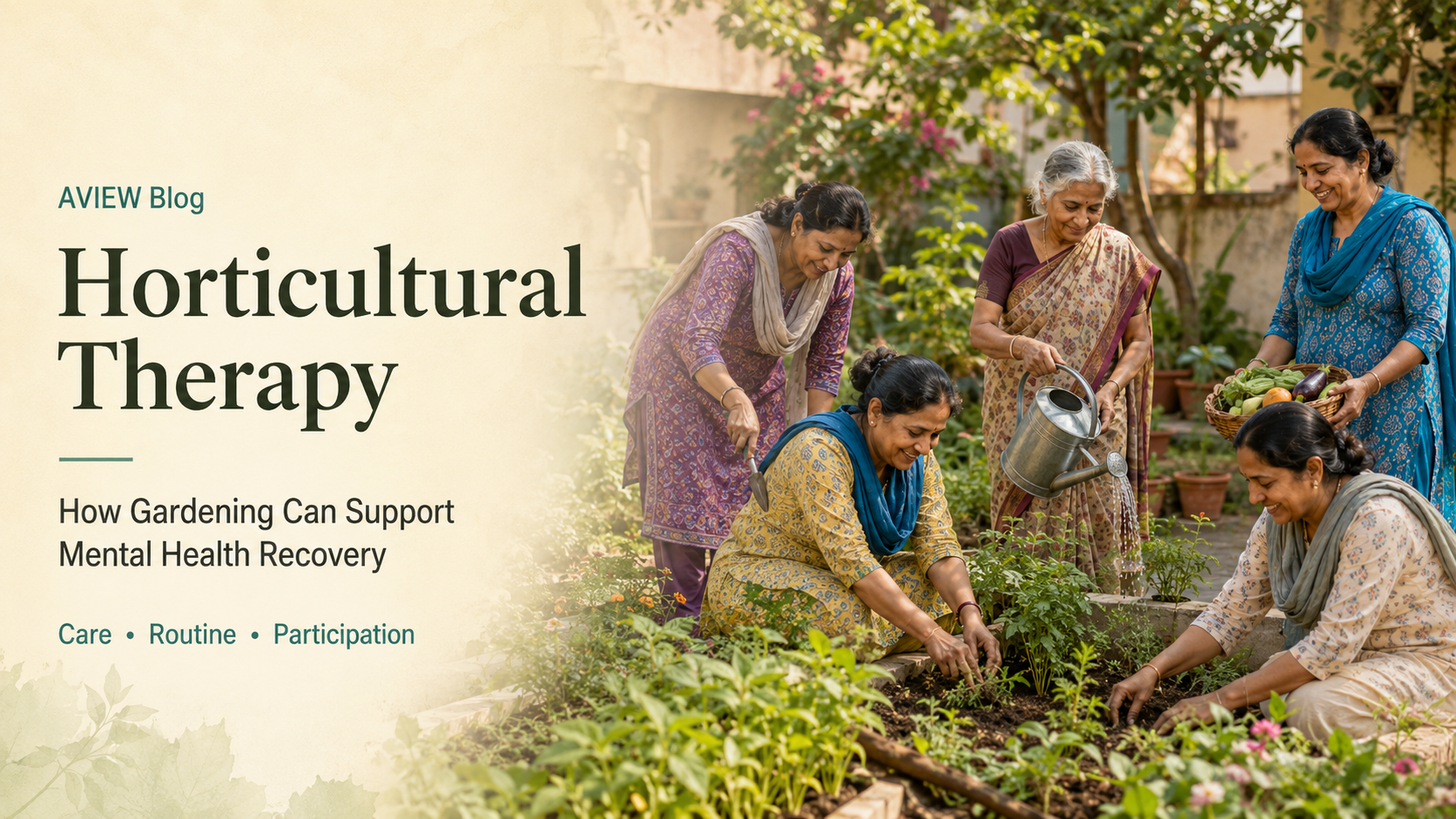
For many people, gardening is simply a way to grow flowers, herbs or food. In mental health care, however, horticultural therapy can take on a more structured role. Working with plants, soil and seasonal routines may support mental wellbeing, social connection and a sense of purpose when used alongside appropriate clinical and psychosocial care.
At AVIEW, A Village for Independent and Enterprising Women, gardening and integrated farming form part of everyday rehabilitation for destitute and abandoned women living with mild to moderate mental illness. AVIEW does not present gardening as a cure or claim that every gardening activity is formal horticultural therapy. Instead, it uses gardening as one of several practical activities that can bring rhythm, responsibility and participation into daily life.
That distinction matters. Gardening does not replace treatment. For some women, it can simply make recovery feel more connected to ordinary life.
What Is Horticultural Therapy?
Horticultural therapy is more specific than simply spending time in a garden.
The American Horticultural Therapy Association defines horticultural therapy as participation in horticultural activities facilitated by a trained horticultural therapist to achieve specific goals within an established treatment, rehabilitation or vocational plan.
Activities may include sowing seeds, watering plants, preparing soil, tending vegetables, pruning or harvesting produce. What gives them therapeutic purpose is the structure around them: a defined goal, appropriate guidance, manageable responsibility and the opportunity to participate in plant-related activity in a meaningful way.
Scientific interest in the field has also grown. A 2024 umbrella review of gardening and horticultural interventions examined 40 previous reviews and found an overall positive association between gardening activities and measures of wellbeing, health and quality of life.
However, the researchers also highlighted considerable variation between studies. This means horticultural therapy should be viewed as a supportive approach rather than evidence that gardening alone can treat every mental health condition.
That is especially important in a rehabilitation setting. Gardening may complement psychiatric care, counselling, medication when prescribed and other forms of psychosocial support. It should not replace them.
How Horticultural Therapy May Support Mental Wellbeing
Gardening brings together movement, sensory experience, attention, routine and contact with nature. These characteristics help explain why horticultural activities are increasingly explored as part of mental wellness and recovery programmes.
A Manageable Task
Psychological distress can sometimes make daily life feel unstructured or overwhelming. Gardening provides a task that is immediate and concrete.
A person can water a plant, prepare a small patch of soil, remove weeds or collect vegetables.
Completing a manageable task may provide a simple sense of achievement. For a woman gradually rebuilding confidence after prolonged distress or instability, being able to think, “I completed this today,” can carry meaning.
The objective is not productivity for its own sake. It is participation.
Contact With Nature
The relationship between nature and mental health has become an important area of public-health research.
The World Health Organization’s work on nature, health and wellbeing highlights links between exposure to natural environments and factors such as stress reduction, physical activity, social interaction and overall wellbeing.
A garden offers repeated contact with sunlight, plants, soil, changing colours and seasonal growth. These experiences can provide a different rhythm from highly enclosed or clinical environments.
For someone living in residential care, being able to step outdoors and participate in growing something may make the surrounding environment feel more lived-in and purposeful.
Gentle Movement and Routine
Gardening can involve walking, bending, watering, carrying light materials and working with the hands.
The activity can be adapted to a person’s physical capacity and does not have to involve strenuous exercise.
Plants also create their own timetable. They need watering, tending and observation. Vegetables mature gradually. Seeds take time to germinate.
That natural rhythm can support a meaningful daily routine.
For women whose lives have been disrupted by homelessness, abandonment or prolonged mental-health difficulties, predictability can become reassuring.
Horticultural Therapy, Stress Relief and Daily Routine
One of the appealing qualities of therapeutic gardening is that it cannot be hurried.
Plants develop at their own pace. Soil has to be prepared. Seeds are planted before anything visible happens. Watering and tending need repetition.
That rhythm can offer a useful contrast to the pressure people sometimes associate with recovery.
Gardening is frequently discussed in relation to stress relief, although the term needs to be used carefully. A garden cannot remove the causes of psychological distress, and spending time with plants does not guarantee an improvement in symptoms.
Instead, gardening can offer a period of focused activity, gentle movement and contact with a natural environment.
A meta-analysis of randomized controlled trials on horticultural therapy and mental health found an overall positive effect of horticultural therapy interventions on mental-health outcomes. As with most research in this area, however, the findings should be interpreted as support for complementary use rather than as evidence that horticultural therapy should replace conventional treatment.
This is why the mental health benefits of gardening are best understood within a wider system of care.
Gardening and Mental Health at AVIEW
At AVIEW, rehabilitation is built around more than medical care alone.
The organisation works with destitute and abandoned women with mild to moderate mental illness and combines treatment support with daily living skills, community life, meaningful activity and gradual pathways towards greater independence.
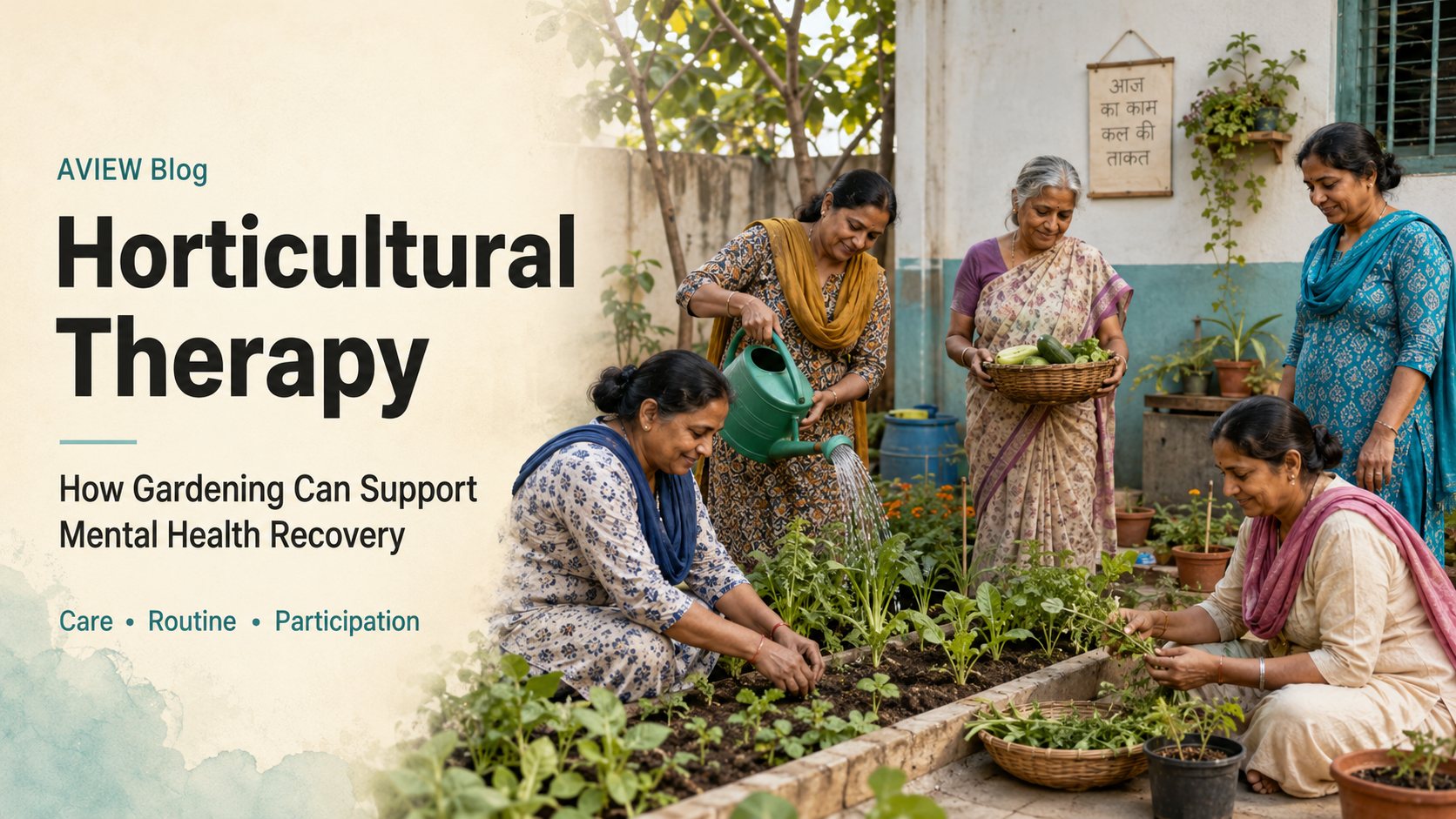
Through The A VIEW Way, residents may participate in gardening, integrated farming, animal husbandry, cooking, sewing, quilting, jewellery-making and other practical activities.
Gardening therefore sits within a much larger rehabilitation environment.
It may provide a manageable task today, develop practical ability over time and allow a woman to contribute to the shared life of the residence.
AVIEW’s Jibantala Organic Farming Initiative reflects this approach. Women undergoing psychiatric care participate in activities connected with sowing, tending and nurturing crops.
The value does not lie only in what is eventually harvested.
Participation itself can create routine. Caring for something introduces responsibility. Seeing a crop grow provides visible evidence that consistent effort can lead to change.
Why AVIEW Does Not Call Every Gardening Activity Horticultural Therapy
This distinction is essential for responsible mental-health communication.
Formal horticultural therapy usually involves defined therapeutic objectives and appropriately trained practitioners working within a structured treatment or rehabilitation plan.
Gardening within a rehabilitation environment can still have considerable value without meeting that formal definition.
For this reason, AVIEW’s activities are more accurately described as gardening, integrated farming, vocational participation and supportive rehabilitation activities unless a particular programme has been formally designed and delivered as horticultural therapy.
Research supports maintaining that distinction.
A recent systematic review and meta-analysis of social and therapeutic horticulture reported promising findings for depression and anxiety, but the authors also identified substantial differences between studies and called for more rigorous research.
The practical message is straightforward: gardening can support wellbeing, while mental health recovery usually requires several forms of support working together.
Mental Health Benefits of Gardening Go Beyond Mood
When people search for gardening for mental health, they often expect to read about relaxation.
For women in long-term rehabilitation, however, some of the most meaningful benefits may have little to do with simply “feeling relaxed.”
Responsibility Without Overwhelming Pressure
A plant offers a relatively simple form of responsibility.
It needs water and care, but it does not demand complicated conversation. A woman can participate quietly and still know that what she is doing matters.
That can be particularly valuable for someone who is not yet comfortable participating in highly social activities.
Visible Progress
Mental health recovery can be difficult to see from one day to the next.
A garden makes change visible.
Seeds germinate. Leaves appear. Plants grow. An empty bed becomes productive.
Visible progress can make effort easier to recognise and may contribute to self-confidence.
Social Connection
Gardening does not have to be solitary.
Shared tasks can create opportunities for conversation, cooperation and peer companionship without making socialising itself the assignment.
Research examining community gardening and psychosocial wellbeing has explored potential benefits involving social connection, community participation and wellbeing.
For women rebuilding trust after abandonment or social isolation, working beside another person may sometimes feel easier than being asked directly to participate in a conversation.
Skills and Confidence
At AVIEW, gardening can also become part of practical skill-building.
Learning to prepare soil, care for plants, participate in organic cultivation or understand aspects of integrated farming can strengthen confidence and vocational participation.
The goal is not to judge a woman by how productive she becomes.
It is to create opportunities for her to experience capability.
Horticultural Therapy and Community-Based Mental Health Care
The broader principles behind horticultural therapy fit naturally with community-based mental health care.
Recovery does not happen only during consultations or inside treatment rooms. People also live within homes, relationships, neighbourhoods and communities.
They need opportunities for purposeful activity, social interaction and participation in ordinary life.
Gardening can bring several of these elements together.
A woman watering vegetables may simultaneously be following a routine, practising a skill, sharing responsibility and contributing to the place where she lives.
This is particularly relevant for women who have experienced prolonged exclusion.
When someone has spent years being viewed mainly through illness or vulnerability, participating in a shared activity can gradually change that relationship.
She is not only receiving care.
She is also tending, learning, contributing and creating.
How to Use Gardening Responsibly in Mental Health Recovery
A rehabilitation activity is useful only when it respects the person taking part.
Gardening should therefore be:
- Voluntary rather than forced
- Adapted to physical ability and comfort
- Safe and appropriately supervised
- Offered alongside different activity choices
- Free from unrealistic claims about recovery
- Integrated with professional mental-health care when needed
Not every woman will enjoy gardening.
One person may prefer stitching. Another may enjoy cooking. Someone else may be more comfortable with animal care, music, craftwork or another form of activity.
Person-centred rehabilitation allows those differences.
The purpose is not to turn everyone into a gardener.
It is to create varied opportunities for participation, routine, connection and self-belief.
Conclusion: Horticultural Therapy Is About More Than Plants
Horticultural therapy offers a useful way to understand how plants, nature and purposeful activity can become part of mental-health support.
Research suggests that gardening and structured horticultural interventions may support mental wellbeing, quality of life, social interaction and some mental-health outcomes. At the same time, the evidence should be interpreted responsibly. Gardening is a complement to appropriate care, not a substitute for it.
For AVIEW, gardening has a deeply practical meaning.
Women take part in gardening and farming not because plants can “cure” mental illness, but because tending something can bring structure, responsibility, connection and visible achievement into everyday life.
Recovery is often built through small experiences: treatment, routine, shared meals, skills, relationships and discovering that one’s contribution still has value.
Sometimes one of those experiences begins with soil, a seed and something worth tending.
Readers can explore AVIEW’s rehabilitation approach or support AVIEW’s work with women with mental illness to learn more about how community life, practical skills and meaningful participation form part of its wider model of care.
Frequently Asked Questions
What Is Horticultural Therapy?
Horticultural therapy is the structured use of gardening and plant-based activities to support defined treatment, rehabilitation or wellbeing goals. Formal programmes generally involve trained practitioners and are used alongside other forms of care.
Is Gardening Good for Mental Health?
Research suggests that gardening can be associated with mental wellbeing, social connection, quality of life and some mental-health outcomes. Results vary, and gardening should not replace professional treatment when treatment is required.
Does AVIEW Provide Horticultural Therapy?
AVIEW incorporates gardening, organic farming and related activities into rehabilitation and everyday life. Unless a programme is formally structured as horticultural therapy, these are more accurately described as supportive rehabilitation, vocational and wellbeing activities.
How Can Gardening Support Mental Health Recovery?
Gardening may provide routine, gentle movement, contact with nature, manageable responsibility, social participation and opportunities to see visible progress.
Why Are Gardening and Farming Relevant to AVIEW?
AVIEW uses practical activities to support routine, confidence, skills and participation for destitute and abandoned women living with mental illness. Gardening and integrated farming are among the activities incorporated into its broader rehabilitation environment.