
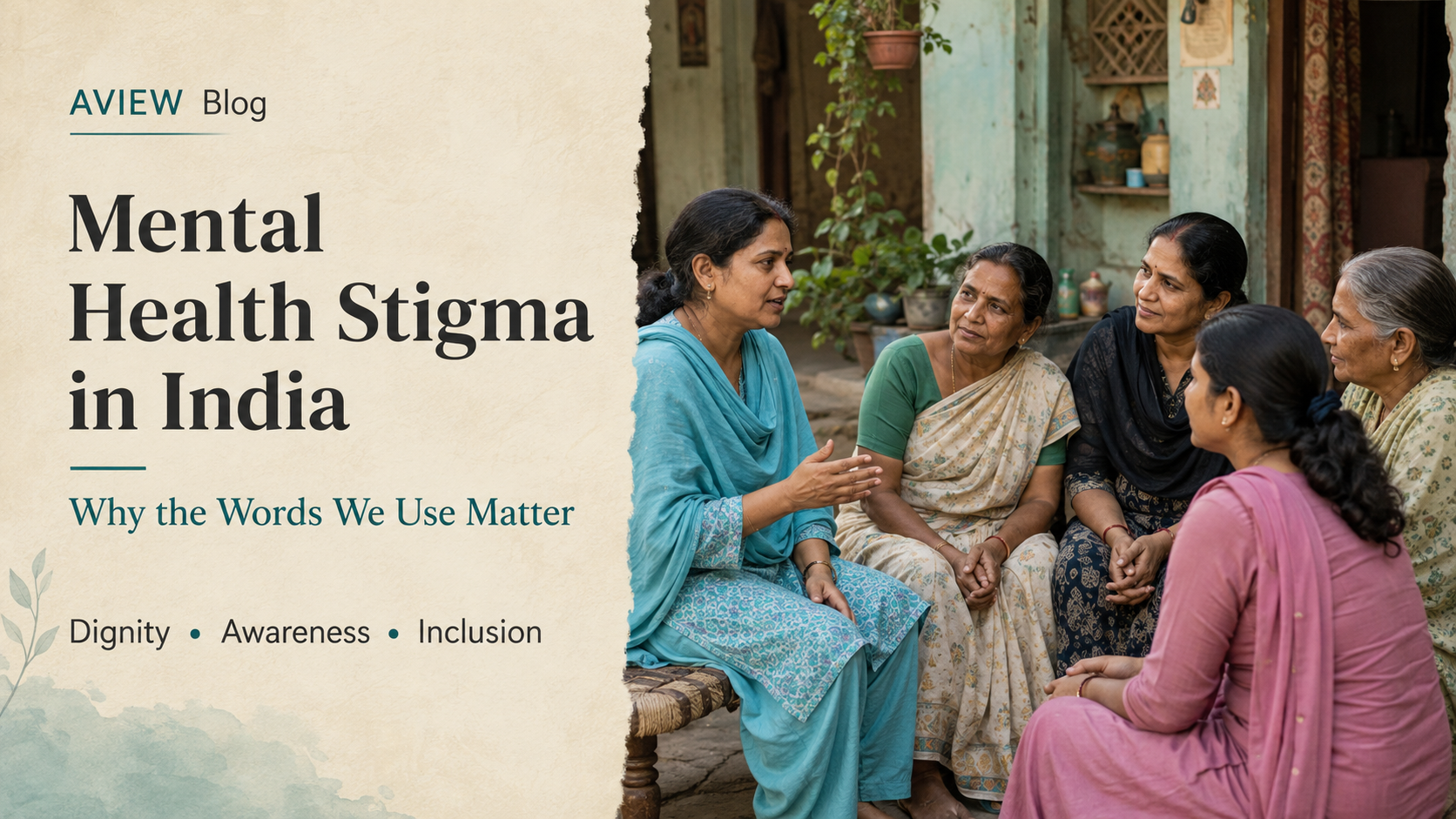
Mental health stigma is not only about hurtful words. It can shape whether someone asks for help, stays in treatment, is welcomed home, finds work, or feels safe enough to participate in everyday life. Changing language is one practical place to begin.
Mental health stigma can be quiet: a joke, a warning whispered to a relative, a label attached to a woman before anyone asks what she needs, or the assumption that a diagnosis makes someone incapable.
At AVIEW, A Village for Independent and Enterprising Women, this issue is especially relevant because the organisation works with destitute and abandoned women living with mild to moderate mental illness, many of whom have also experienced homelessness, rejection or loss of stable support.
Mental health awareness matters. But awareness becomes meaningful only when it changes how we speak, respond and make room for people to belong.
What Is Mental Health Stigma?
Mental health stigma refers to negative beliefs, stereotypes and discriminatory attitudes towards people living with mental health conditions. The World Health Organization notes that people with mental health conditions continue to experience stigma, discrimination and human-rights violations worldwide.
Public stigma appears in society’s assumptions that people with mental illness are dangerous, unreliable or incapable. Self-stigma develops when a person begins to internalise those messages. Structural stigma appears when systems or social practices limit access to housing, employment, healthcare or community participation.
For women, stigma can overlap with gender, poverty, family expectations and financial dependence. A woman may therefore face judgement not only for having a mental health condition, but also for being separated, homeless or dependent on others for care.
Why Mental Health Stigma in India Can Delay Help
Stigma does not only hurt feelings. It can change behaviour.
A study on care-seeking for mental illness in India found that beliefs about mental illness, stigma and wider social factors can influence whether and how people seek care.
A woman may delay treatment because she fears neighbours will find out. A family may avoid a psychiatric consultation because of social judgement. Someone may stop medication because taking it feels like publicly accepting a label.
India’s National Mental Health Programme includes public awareness and stigma reduction within its community mental-health approach.
This is why mental health education matters. Accurate information can challenge myths, but people also need to see that recovery, participation and meaningful relationships are possible.
The Words We Use Can Reinforce Mental Health Stigma
Language influences how people are seen.
Words that reduce someone to an illness can make her seem less human, less capable and less deserving of choice. Casual labels may also discourage people from admitting that they are struggling.
Instead of describing someone as “a mental patient,” it is more respectful to say “a person living with a mental health condition” or “a woman receiving mental health support.”
Instead of asking, “What is wrong with her?” we can ask, “What support might she need?”
Respectful language does not deny the seriousness of mental illness. It simply separates the person from the diagnosis. Dignity in mental health care begins with this distinction.
Mental Health Awareness Is More Than Knowing the Symptoms
Mental health awareness often focuses on recognising symptoms. That is useful, but awareness should also mean understanding that mental health conditions are not moral failures, recovery may include setbacks, and a person can need help in one area while remaining capable in another.
If knowledge does not change exclusionary behaviour, it has not yet become inclusion.
This matters because awareness campaigns can sometimes stop at information. People may learn the vocabulary of mental health while continuing to treat someone differently after a diagnosis.
Real mental health awareness asks us to examine behaviour too.
Do we still invite her to family events?
Do we ask for her opinion?
Do we assume she cannot work?
Do we discuss her health without her consent?
The answers tell us whether awareness has genuinely challenged stigma.
How Mental Health Stigma Affects Women Differently
Women can experience mental illness within social systems that already place strong expectations on marriage, caregiving and family roles. A woman who becomes psychologically unwell may be judged for not meeting those expectations; if she is separated from family or homeless, the judgement can become harsher.
For destitute women with mental illness, stigma can compound existing vulnerability. The same visible signs of distress that indicate a need for care may cause others to withdraw, increasing exclusion.
Economic dependence can make the situation more difficult. If a woman relies entirely on family members for treatment, housing or daily needs, stigma within that support system can directly affect her access to care.
This is why mental health support for women cannot focus only on symptoms. Social circumstances matter too.
Social Contact Can Help Reduce Mental Health Stigma
One of the strongest ways to challenge stereotypes is to create opportunities for respectful contact.
The WHO has highlighted social contact as an important approach to tackling stigma. Meeting, working with and listening to people who have lived experience of mental-health conditions can challenge assumptions more effectively than abstract messaging alone.
At AVIEW, community participation is part of the wider rehabilitation environment.
Through The A VIEW Way, women participate in daily living activities, gardening, sewing, animal care, farming, jewellery-making and other practical tasks alongside treatment and support.
These activities matter not because productivity determines a woman’s worth, but because participation makes ability visible.
A woman known only through a diagnosis can also be a gardener, cook, craftsperson, friend or neighbour.
That broader identity challenges the idea that mental illness should define an entire person.
Why Community Acceptance Matters for Mental Health Recovery
Mental health recovery does not happen in isolation.
A woman may become clinically stable and still struggle if family or community rejection continues. For AVIEW, social reintegration is therefore not simply a final step after rehabilitation; it is part of restoring dignity and participation.
The organisation’s success stories show that recovery can take different forms. For some women, it may include reconnecting with family. For others, the pathway may involve supported living, meaningful work or greater independence.
Community acceptance makes those possibilities more realistic.
It can be as simple as a neighbour greeting someone normally after she returns home, a relative including her in decisions, or a workplace judging her by her ability rather than a past diagnosis.
These actions may seem ordinary. That is precisely why they matter.
Inclusion should become ordinary.
Mental Health Education Should Challenge Myths
Mental health education works best when it addresses assumptions people actually carry.
One common myth is that people with mental illness cannot make decisions. Some people may need additional support during periods of severe illness, but that does not mean they should automatically lose their voice in every area of life.
Another misconception is that relapse means treatment has failed. Mental health recovery is not always linear. Symptoms can return or change, and treatment plans may require adjustment.
Social isolation is also sometimes mistaken for protection. Short-term clinical care may be necessary in some circumstances, but keeping someone permanently away from ordinary life is not the same as treatment.
Finally, speaking openly about mental health does not make people weak. Respectful conversation can make mental health help easier to seek.
What Families Can Do to Reduce Mental Health Stigma
Families can be powerful sources of mental health support. They can protect privacy, use the woman’s name rather than a diagnosis as her identity, include her in ordinary conversations and learn about mental illness from reliable sources.
Support can also mean avoiding constant surveillance.
If treatment is prescribed, families can encourage consistency without making every meal or conversation revolve around illness. They can offer manageable responsibilities and acknowledge progress without expecting recovery to follow a fixed timetable.
Families may also need guidance. India’s Tele-MANAS service provides 24-hour tele-mental health support through 14416 and 1800-89-14416, with links to further services.
Seeking guidance can be part of responsible care.
How AVIEW Approaches Dignity Beyond the Diagnosis
At AVIEW, rehabilitation is built around the idea that women with mental illness need more than symptom management.
They need safety, treatment support, routines, relationships, skills, meaningful participation and pathways towards social reintegration.
That is why AVIEW’s rehabilitation approach includes activities of daily living and vocational skills alongside medical care and relapse-prevention support.
The principle is simple: illness may affect a woman’s life, but it should not erase her identity.
When a woman is trusted with responsibility, invited into an activity or recognised for what she contributes, the focus shifts from limitation to possibility.
This also challenges stigma in a way that awareness posters alone cannot.
People begin to see a woman’s abilities, relationships and personality alongside her mental-health needs.
What Each of Us Can Do
Reducing stigma does not require everyone to become a mental-health expert.
Pause before repeating a joke about mental illness. Correct misinformation. Do not photograph or publicly expose someone who is visibly distressed. Use respectful language, encourage professional mental health help without shame, and listen without assuming you know someone’s experience.
Think about the labels used in everyday conversation. Ask whether those words would feel acceptable if they were being used about someone you cared for.
Mental health awareness grows through these small choices.
Most importantly, do not make diagnosis the only thing you see.
Mental health support becomes more humane when people are treated as members of families and communities, not as labels.
Conclusion: Changing Mental Health Stigma Starts With How We See People
Mental health stigma survives through language, fear, stereotypes and exclusion. It can delay treatment, weaken relationships and make recovery more difficult.
Mental health awareness is therefore not only about recognising symptoms. It is also about changing attitudes.
At AVIEW, women living with mental illness are supported through care, routine, skills and community participation because recovery includes more than clinical stability. It also includes dignity, belonging and the chance to be recognised for who a person is beyond illness.
We may not be able to change every social attitude overnight. But we can change the words we use, the assumptions we repeat and the way we respond to someone who needs support.
That is where mental health stigma begins to lose its power.
Readers can support AVIEW’s work or learn more about AVIEW’s mission and approach to help create communities where women with mental illness are treated with dignity, acceptance and respect.
Frequently Asked Questions
What is mental health stigma?
Mental health stigma includes negative beliefs, stereotypes and discrimination directed towards people living with mental-health conditions. It can affect relationships, work, community participation and willingness to seek treatment.
Why is mental health stigma a problem in India?
Research in India has linked stigma and discrimination with barriers in mental-health help-seeking. Social expectations, misinformation and fear of judgement can all influence whether people access care.
How can mental health awareness reduce stigma?
Mental health awareness can challenge myths, improve understanding of treatment and encourage respectful conversations. It is most effective when knowledge leads to changes in behaviour and social inclusion.
What language should we use when discussing mental illness?
Use language that recognises the person before the condition. Avoid labels, mockery and assumptions about ability. Speak about mental health in the same respectful way you would discuss other health conditions.
How does AVIEW support women with mental illness?
AVIEW supports eligible destitute and abandoned women with mild to moderate mental illness through residential care, treatment support, daily routines, practical skills, vocational activities and pathways towards social reintegration.